


 BLOGGER


SPORTS
Behaviour And Work Habbits In The Workplace

Smart and quiet behaviour in the workplace can cause serious or even fatal accidents. Behaviour like this is called horseplay. If you interfere with the work of others or make practical joking, it can also be very safe. Horseplay, running, and throwing objects in the workplace are good work habits
and can cause accidents.
Bad work habits keep a workplace dangerous. A dangerous worker is messy in his habits. He keeps a messy bench and a messy store. The floor around the bench or machine is never dirty. He always puts rubbish and waste into the wrong bins. In this way, he prevents obstruction of fire.
A dangerous worker does not wait for accident to happen. He never takes actions after they happen. If he sees some oil on the floor, he does not leave it there. Somebody may slip on that oil and so he wipes it up.
He does not leave tools lying around or on top of machines. Tools can fall into the moving parts of a machine. The machine may be damaged, or the operator may be badly injured.
The dangerous worker does these things through habits. As he works, he is thinking of the safety. He is trying to remove the safety. He is thinking not only of himself, but also of his fellow workers.
The Mightiest Archipelago

The Indonesian archipelago is by far the world's largest group of 13.667 islands which stretches across 5,120 km (3,200 miles) of tropical seas like a string of emeralds. When superimposed on a map of North America, Indonesia stretches from Oregon all the way to Bermuda. On a map Europe, the archipelago extends from Ireland past the Caspian Sea. More than 200 million people inhabit this archipelago.
Known to anthropologists and naturalists as "The Malay equatorial line", the equatorial line is an imaginary line dividing the earth in two parts from east to west in the tropical zone.This makes Indonesia have two seasons, the wet and dry seasons. Because of its location many kinds of flora and fauna live here. According to the astronomical location, Indonesia lies between 6° North Latitude and 11 ° South Latitude and between 95° East Longitude and 141° East Longitude.
Should children be allowed to stay in at break times?

A group of children at tree-school feel they should have the right to stay in at break times if they want to. There are a number of impracticalities regarding such a ridiculous idea but the foolish children appear not to have considered them
Firstly, the children have to be supervised at all times and with children inside and outside this would not be possible. The budget for lunch time stuff is already being stretched and there is certainly not enough money to employ extra staff just to satisfy these selfish children.
Some of the children are suggesting that the teachers could supervise them if they choose to be indoors at playtime. Are the teachers not working hard enough already? Do they not deserve 50 minutes to reflect on the morning? Do they not use the 50 minutes to prepare for the afternoon? Asking the teachers to supervise the children is beyond their description.
Everybody knows that air is needed to help the brain at its best. In a recent study. Oxford University found that children’s concentrate tripled once they had been outside. If children were allowed to stay cooped up inside all day their concentration would suffer.
Of course some people might say it’s unfair to make children go outside on a cold day. However, it has been proven that colds and illness spread in warm conditions. So. being outside is actually beneficial to their health. Plus they run around and get some exercises outside. Children need to go outside at break times. They need fresh air and exercise for their health. Teachers need a break for prepare, reflect and relax. However, the fundamental reason why children cannot stay in at break times is because there is just not enough money to provide supervision.
Meat Floss Porridge

- 250 cc hot water
- 50 gram instant soya sauce
- 1 spoon soya sauce
- 1 spoon chili sauce
- Crackers
- 10 gram meat floss
Suggested Preparation
1. Put instant porridge into a bowl
2. Pour 250 cc hot water, stir well. Leave it for about 3 minutes until porridge thickened.
3. Add soya sauce and chili sauce (as much as you like)
4. Then, spread crackers and meat floss, The porridge is ready to be observed
A Theatre

A theatre can be anywhere - in homes, school auditorium, park and a hall. Theatre means action. In this text, theatre is used in connection with performances on stage by live actors and actress. It is living theatre.
Theatre in the East differs greatly from the west. The Asian theatre is, for the most part, nonrealistic, or symbolic. Western theatre, on the other hand, tends to be realistic.
Mangrove Trees

There are several species or mangrove trees found all over the world. Some prefer more salinity, while others like to ber very close to a large fresh water source (such as a river). Some prefer areas that are sheltered from waves. Some species have their roots covered with sea water every day during high tide. Other species grow on dry land, but are still part of the ecosystem.
Mangroves need to keep their trunk and leaves above the surface of the water. Yet they also need to be firmly attached to the ground so they also need leaves above by the waves. There are three types of mangrove root that play an important role for it:
- Support roots which directly pierce the soil
- Level growing roots which twist upwards and downward, with the upward twist emerging on the water surface.
- Level-growing roots whose downward twist (sub-roots) appear on the water surface.
Any part of a root that appears above the water flows oxygen to the plant under surface. As the soil begins to build up, these roots produce additional roots that become embedded in the soil.
Use Of Formalin And Other Additives In Foods

The use of formalin and other dangerous preservatives in food has been a serious for two reasons. Firstly, formalin is not for human beings, but it is for biological specimen and experiments. Formalin in Biology is a 10% solution of formaldehyde in water which is usually used as a disinfectant or to preserve biological specimens. Thus, it is not for food preservative, it will be very dangerous to human’s body.
The second reason is that there is no tight control from the government. This condition makes the people’s health is really in a threat. When the control is weak and the use of formalin is spread wide all over the Indonesian regions, and these days it has really happened, the citizens’ bodies will be badly contaminated with the poisons. Fish or food traders still sell their products which contain formalin and dangerous preservatives.' Can you imagine that our digestive system absorbs the substance that should be for the human and animal corpses?
Considering the reasons, we can make a conclusion that the use of formalin and other preservatives is really a serious problem if it is not resolved immediately.
Debating

Debate is an activity of an argument between two or more parties, either individually or in groups, in discussing and deciding issues and differences.
In this simple debate, two groups are going to be given the same topic. One group is on the pro side which means agreeing with the case, while the other group is on the oppposing side which means disagreeing with the case.
Each group has to give their opinions about the case. Some example cases that can be debated are:
1. Fishermen are only allowed to catch limited amount of fish everyday.
2. Shark hunters should be given serious punishment.
3. Only school students who live on the coastal areas should learn about marine life.
Jakarta

Jakarta is the capital of the Republic of Indonesia. It has a population of six million, the largest of any urban center in the southeast Asia. It is located on the alluvial plain of Ciliwung River in northwestern Java. The city is coextensive with its metropolitan area, Jakarta Raya and forming a special capital region. The city has expanded from the Kota, or Old city and now includes the modern port of Tanjung Priok.
The majority of the city's residents are Moslem from west, central and east Java. In the last 30 years, heavy immigration, primarily from the densely populated areas of Java, has encountered for much of the rapid growth. Jakarta is the major industrial and commercial center in Indonesia with textiles and food processing among its more important industries.
Jakarta's port is the nation's center of Indonesia. The Museum of Indonesia Culture, houses both domestic and overseas flights.
Jakarta is also the cultural center of Indonesia. The Museum of Indonesia culture houses both ancient and modern works art.
The University of Indonesia and nine private universities are located here.
Jakarta was settled as a trading center by Hindus and Buddhist from India about 15th century. The Portuguese dominated the area in the 14th century, but they were ousted by the Sultan of Bantam in 1527. He named the city Jayakarta, meaning ." glorious fortress ".
The Enchanted Fish

When the fisherman went home to his wife, he told her everything that had happened and how, on hearing it speak, he had let it go again. “Didn't you ask it for anything?” said the wife. “No, I didn't, what should I have asked for?” replied the fisherman.
“I am surprised you don't realize what you should have asked for. We live very wretchedly here, in this nasty dirty hut. We are poor and I am so miserable. You should have asked for a nice cozy cottage. Now go back and ask the fish that we want a snug little cottage”, said his wife.
The fisherman wasn't sure about this but he still went to the seashore, sat in his boat, went to the middle of the sea and said:
“O enchanted beautiful fish!
Hear my plea!
My wife wants not what I want, and
she won't give up till she has her own will,
so come forth and help me!”
The fish immediately came swimming to him, and said, “Well, what is her will? How can I help your wife?” “Ah!” said the fisherman, “she says that when I had caught you, I ought to have asked you for something before I let you go. She does not like living in our little hut, and wants a snug little cottage.” “Go home, then,” said the fish, “She is already in the cottage!” So the fisherman went home, and saw his wife standing at the door of a nice trim little cottage. “Come in, come on in! Look at the beautiful cottage we have.” Everything went fine for a while, and then one day fisherman's wife said, “Husband, there is not enough room for us in this cottage, go back to the fish and tell him to make me an emperor.” “Wife,” said the fisherman, “I don't want to go to him again. Perhaps he will be angry. We ought to be happy with what the fish has given us and not be greedy.” “Nonsense!” said the wife; “The fish will do it very willingly, I know. Go along and try!” With a heavy heart the fisherman went to the middle of the sea and said:
“O enchanted beautiful fish! Hear my plea!
My wife wants not what I want,
and she won't give up till she has her own will, so come forth and help me!”
“What would she have now?” said the fish. “Ah!” said the fisherman, “she wants to be an emperor.” “Go home,” said the fish; “She is an emperor already.”
So he went home and he saw his wife sitting on a very lofty throne made of solid gold, with a great crown on her head full two yards high. And on each side of her stood her guards and attendants in a row. The fisherman went up to her and said, “Wife, are you an emperor?” “Yes”, said she, “I am an emperor.” “Ah!” said the man, as he gazed upon her, “What a fine thing it is to be an emperor!” “Husband,” said she, “it is good to be an emperor.” They were happy for a while.
Then a time came when she was not able to sleep all night for she was thinking what she should ask next. At last, as she was about to fall asleep, morning broke, and the sun rose. “Ha!'” thought she, as she woke up and looked at it through the window, “after all I cannot prevent the sun from rising.” At this thought she was very angry, and wakened her husband, and said, “Husband, go to the fish and tell him I must be Lord of the sun and the moon.” The fisherman was half asleep, but the thought frightened him so much that he fell out of the bed.
“Alas, wife!” said he, “cannot you be happy with being such a powerful emperor?” “No,” said she, “I am very uneasy as long as the sun and the moon rise without my permission. Go to the fish at once!” “I don't think this is a good idea,” said the fisherman but his wife wouldn't listen to him. “ Why don't you just go and ask the fish to make me the Lord of everything,” she said.
Then the man went shivering with fear. As he was going down to the shore a dreadful storm arose. The trees and the very rocks shook and the sky became black with stormy clouds. There were great black waves, swelling up like mountains with crowns of white foam upon their heads. Unfortunately the fisherman did not have any choice, so he got onto his boat and rowed to the middle of the sea and cried out as loud as he could:
“O enchanted beautiful fish! Hear my plea!
My wife wants not what I want,
and she won't give up till she has her own will, so come forth and help me!”
“What does she want now?” said the fish. “I am truly ashamed of my wife's greed but I can't do anything. She wants to be Lord of the sun and the moon. “Go home,” said the fish, “to your small hut.” And it is said that they live there to this very day.
(Adapted from Grimm Brothers, 1812. “The fisherman and his wife”)
The Scientist Help Sheep Dies

He began researching animal cloning at the Roslin Institute near Edinburgh in 1991. In 1996 the experiments led to the birth of Dolly the sheep, the first mammal to be cloned from an adult cell.
The sheep was named after the voluptuous singer Dolly Parton. Researchers at the time said that the sheep was created from a mammary gland cell, and that Parton offered an excellent example.
The creation of the sheep captured the public imagination and instantly became a scientific sensation. The experiments drew not only admiration but also anger from some who raised questions about the ethics of cloning. Animal rights activists were outraged, while the church of England expressed reservations. Dolly was put down in 2003 after she developed a lung disease. Campbell's interest in cellular growth dated back to his college days studying microbiology in London.
Higher Education for Women
In this modern era, there are still some parents who are reluctant about sending their daughters to college. The narrow attitude shown to women's education is largely due to the traditional role of women in society. A woman is expected to be a wife and a mother. Most parents believe that if their daughter gets married and chooses to be a housewife, then the higher education will be a waste. However, an educated woman is not only a better wife but also contributes something to the society.

Nowadays, more and more women are successfully combining their career and marriage. Educated women are richer both emotionally and financially. They are able to find an outlet for their monotonous drudgery of their housekeeping. They bring more satisfaction and contentment to their lives.
Depriving girls of higher education is crass discrimination. Times have changed; modern society needs the talents of its people regardless of gender. Today, women work alongside men. In fact, in the last few decades, women have made outstanding contributions to society.
Women should be given the freedom to be educated whether or not they get married or go to work after finishing their education, because it is only through education that a woman will find herself useful and discover what she wants in life. A woman who works is not an insult to her husband. Conversely, her husband should feel proud of her achievements since marriage is actually an equal partnership.
Therefore, parents should not think that girls should receive less education just because they will get married one day.
Nowadays, more and more women are successfully combining their career and marriage. Educated women are richer both emotionally and financially. They are able to find an outlet for their monotonous drudgery of their housekeeping. They bring more satisfaction and contentment to their lives.
Depriving girls of higher education is crass discrimination. Times have changed; modern society needs the talents of its people regardless of gender. Today, women work alongside men. In fact, in the last few decades, women have made outstanding contributions to society.
Women should be given the freedom to be educated whether or not they get married or go to work after finishing their education, because it is only through education that a woman will find herself useful and discover what she wants in life. A woman who works is not an insult to her husband. Conversely, her husband should feel proud of her achievements since marriage is actually an equal partnership.
Therefore, parents should not think that girls should receive less education just because they will get married one day.
Adoption

Parents place their children up for adoptions for many reasons. Some parents feel they cannot adequately care for their off springs because of health or economic conditions. Some others, especially unwed parent, may not want to raise a child.
But there are couples who cannot have children of their own. Adoption gives them opportunity to raise a family. They can get one from an adoption agency if they have all the requirements asked.
State laws prohibit adoption agencies from revealing the identity of the natural parents to the adoptive parents. These laws also forbid agencies from disclosing the identity of the adoptive parents to the natural parents. In some states, the law permits adopted persons who are at least 18 years old to see their birth certificates including the natural parents' names.
On the contrary, many adopted people worked to change the laws. They argue that people have a right to know their identity. They said that keeping secret their adoptions records violate their right.
On the other hand, many people feel adoption records should be kept secret. If not, natural parents might change their minds years later and take the child away from the parents who raised him or her.
Some experts advise that a child should know of the adoptions by the age of 6 or 7. Surveys have shown that most adopted children develop normally.
Let's Make the City Clean and Fresh
A clean and fresh city will surely make the inhabitants healthy. Every morning especially in dry season, all roads must be watered with clean water and swept by the workers of regional government under the mayor's instruction.

To protect people from heavy pollution caused by cars, trucks and motorcycles, enough trees must be planted along the roads. Every building or house in the city must be surrounded by short and small trees which bear colorful flowers.
Bad and improper habits which cause disadvantages, such as smoking and throwing rubbish anywhere should be stopped at once.
The city mayor will have to think over the way to educate people, so they realize how important cleanliness and health are. More public lavatories are badly needed.
It will be wise if the city mayor decides a certain amount of fine to be paid by those who break the government regulation on cleanliness matter, For example, a man who urinates not at a lavatory, smokes not at a smoking room or throws rubbish at the roads should be fined. Besides dirtying the environment with cigarettes' butts, smoking will also cause pollution and bad lung diseases to other people.
So, bad habits and impolite attitude should be immediately stopped, otherwise the city will be dirty, unhealthy, badly polluted and will never attract foreign and domestic tourists as well.
To protect people from heavy pollution caused by cars, trucks and motorcycles, enough trees must be planted along the roads. Every building or house in the city must be surrounded by short and small trees which bear colorful flowers.
Bad and improper habits which cause disadvantages, such as smoking and throwing rubbish anywhere should be stopped at once.
The city mayor will have to think over the way to educate people, so they realize how important cleanliness and health are. More public lavatories are badly needed.
It will be wise if the city mayor decides a certain amount of fine to be paid by those who break the government regulation on cleanliness matter, For example, a man who urinates not at a lavatory, smokes not at a smoking room or throws rubbish at the roads should be fined. Besides dirtying the environment with cigarettes' butts, smoking will also cause pollution and bad lung diseases to other people.
So, bad habits and impolite attitude should be immediately stopped, otherwise the city will be dirty, unhealthy, badly polluted and will never attract foreign and domestic tourists as well.
The Rabbit's Revenge
Long, long ago a rabbit and a lion were neighbors. The lion was very proud, and was fond of boasting about his strength. And though they were such close neighbors, the lion looked down upon the rabbit, and used to bully and frighten her. Finally, the rabbit could stand it no longer and wanted to get her own back.
One day she went to the lion and said, "Good day, respected elder brother. Imagine it, I met an animal over there who looked exactly like you, and he said to me, Is there anyone in the world who dares stand up to me? If there is, let him come and have a duel with me. If there is no one, all of you have to submit to my rule and be my servants!". "Oh, he was an intolerable braggart! He is so puffed up with pride that his eyes can't even light on anyone!", added the rabbit.
"Oho," the lion said. "Didn't you mention me to him?"
"Yes, indeed," the rabbit replied. "But it would have been better if I hadn't. When I described how strong you were, he just sneered and said dreadfully rude things: He even went so far as to say that he wouldn't take you for his attendant!"
The lion flew into a rage and roared, "Where is he? Where is he?"
So the rabbit took the lion behind a hill and, not going too near herself, pointed to a deep well from a distance, and said, "He is down there, in the well."

The lion hastened to the well and glared angrily into it. Yes, there was his rival who even glared back at him angrily. The lion roared, and his enemy roared back. The lion became so furious that his hair stood on end. So did his enemy's in the well. The lion showed his teeth and lashed out with his paws to' scare his rival. and his enemy in the well retaliated! In a fit of anger the lion sprang into the air with all his might and then flung himself at the enemy in the well. The result was that the proud lion was instantly drowned. .
One day she went to the lion and said, "Good day, respected elder brother. Imagine it, I met an animal over there who looked exactly like you, and he said to me, Is there anyone in the world who dares stand up to me? If there is, let him come and have a duel with me. If there is no one, all of you have to submit to my rule and be my servants!". "Oh, he was an intolerable braggart! He is so puffed up with pride that his eyes can't even light on anyone!", added the rabbit.
"Oho," the lion said. "Didn't you mention me to him?"
"Yes, indeed," the rabbit replied. "But it would have been better if I hadn't. When I described how strong you were, he just sneered and said dreadfully rude things: He even went so far as to say that he wouldn't take you for his attendant!"
The lion flew into a rage and roared, "Where is he? Where is he?"
So the rabbit took the lion behind a hill and, not going too near herself, pointed to a deep well from a distance, and said, "He is down there, in the well."
The lion hastened to the well and glared angrily into it. Yes, there was his rival who even glared back at him angrily. The lion roared, and his enemy roared back. The lion became so furious that his hair stood on end. So did his enemy's in the well. The lion showed his teeth and lashed out with his paws to' scare his rival. and his enemy in the well retaliated! In a fit of anger the lion sprang into the air with all his might and then flung himself at the enemy in the well. The result was that the proud lion was instantly drowned. .
How Chocolate is made?
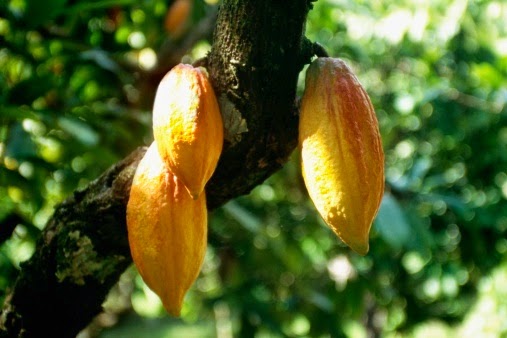
Chocolate is taken from a tree called cacao tree. This tree grows in equatorial regions, especially in places such as South America, Africa, and Indonesia. The cacao tree produces a fruit about the size of a small pine apple. Inside the fruits are the tree's seeds. They are also known as coco beans.
Next, the beans are fermented for about a week, dried in the sun. After that they are shipped to the chocolate maker. The chocolate makers work by roasting the beans to bring out the flavour. The beans from different places have different qualities and flavour. So they are often sorted and blended to produce a distinctive mix.
The next process is winnowing. The roasted beans are winnowed to remove the meat nib of cacao bean from its shell. Then the nibs are blended. The blended nibs are grinds to make liquid. The liquid is called chocolate liquor. It tastes bitter.
All seeds contain some amount of fat and cacao beans are not different. However, cacao beans are half fat. It is pure bitter chocolate.
House Husbands' Heart Risk

According to Dr Elaine Eaker,.the key to the problem is that some men became stressed about performing a role not traditionally assign to them by society. Men who stay at home tend not to have the same levels of support from friends and family as women do the same.
Jack O'Sullivan, of the Fathers Direct group, was quoted as saying: "Society expects the main career should be a woman and society is structured around that. Day care is called mother and toddler groups and some men feel awkward about belonging to those groups.
Professor Gary Cooper, a psychologist at the University of Manchester, said many men tend to underestimate the task of caring for a family. He said 'Most men think being a house husband involves putting on a bit of washing, taking the kids to school and then putting their feet up with a cup of coffee.
They are crazy. Most men are not used to performing a variety of activities simultaneously - the kind of multi-tasking which is second nature to most women.'
It is estimated that men have taken over the main homemakers role in one in seven homes, as increasing numbers of women become the main breadwinner. The study also found that women in high-powered jobs were more likely to develop heart disease than those in more junior positions.
Irrigation

In the mid - 1980’s, about 220 million hectares of land were under irrigation through out the world’s driest continent.
The amount of water needed for farming varies with the type of crop and the climate. For example, rice requires more water than cotton. Wheat grows in a warm climate needs more water than wheat that grows in cool climate. Any form land must receive enough water to allow both for plants growth and for the evaporation of water from the soil.
In some countries, more water is used for irrigation than for any other purposes. Water conservation and irrigation schemes may be vitally important to a country’s food and agricultural production. As the world is.
Population grows, the demand for water increase steadily. More and more people need water in their homes, and industry must have additional water as production rises.
Irrigation requires large supplies of fresh water. The two main sources of fresh water are surface water and ground water. Surface water is water on the surface of the earth such as in streams, rivers, and lakes. Ground water is stored banners the earth’s surface in spaces between rocks, grains of sand, and other substances, in soil.
The Western alphabet

The Western alphabet, which is used in Europe, the Americas, Africa, Australia and New Zealand as well as in other countries, originated in the Middle East. The people who gave the world this alphabet were the Phoenicians, a people who established colonies all over the Mediterranean, including Carthage in Africa and Gades in Spain. In their alphabet, the letters were represented by little pictures which represented sounds. The Phoenician A was aleph, which means "bull". and it was made from a little picture of a bull's head. The letter B was beth which meant "house", and showed the round-roofed buildings which you can still see today in Syria.
The Phoenicians had contact with another nation of sailors, the Greeks, with whom they fought and traded. The Greeks also started to use the Phoenician alphabet. They changed the names so aleph and beth became alpha and beta. The shapes of the letters are the same but they have been turned sideways. Of course, the first two letters of the alphabet give it its name. Over the years there have been changes. Latin developed an alphabet with some different letters to the Greeks, and other letters have been added since. But really westerners are using the same system of writing which has served them so well for thousands of years.