How Chocolate is made?

Have we wondered how we get chocolate from? Well this time we will enter the amazing world of chocolate so we can understand exactly how chocolate is made.

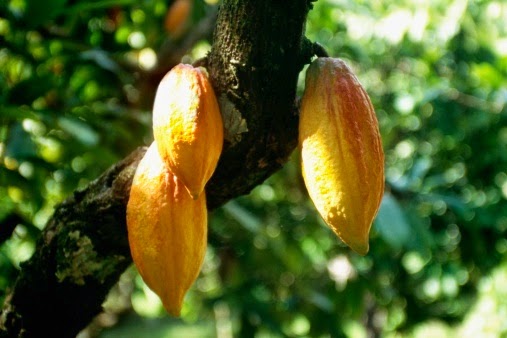
Chocolate is taken from a tree called cacao tree. This tree grows in equatorial regions, especially in places such as South America, Africa, and Indonesia. The cacao tree produces a fruit about the size of a small pine apple. Inside the fruits are the tree's seeds. They are also known as coco beans.

Next, the beans are fermented for about a week, dried in the sun. After that they are shipped to the chocolate maker. The chocolate makers work by roasting the beans to bring out the flavour. The beans from different places have different qualities and flavour. So they are often sorted and blended to produce a distinctive mix.

The next process is winnowing. The roasted beans are winnowed to remove the meat nib of cacao bean from its shell. Then the nibs are blended. The blended nibs are grinds to make liquid. The liquid is called chocolate liquor. It tastes bitter.

All seeds contain some amount of fat and cacao beans are not different. However, cacao beans are half fat. It is pure bitter chocolate.

House Husbands' Heart Risk

Most people assume that life in the rat race is bad for your health. But reversing the traditional gender roles, being a house husband is a stressful business, according to the latest research by American scientists. By giving up their jobs in order to become house husbands, men increase their risk of heart attack or coronary disease by as much as 82%, according to research based on 10 year study of 2.500 people in Boston, USA.

According to Dr Elaine Eaker,.the key to the problem is that some men became stressed about performing a role not traditionally assign to them by society. Men who stay at home tend not to have the same levels of support from friends and family as women do the same.

Jack O'Sullivan, of the Fathers Direct group, was quoted as saying: "Society expects the main career should be a woman and society is structured around that. Day care is called mother and toddler groups and some men feel awkward about belonging to those groups.

Professor Gary Cooper, a psychologist at the University of Manchester, said many men tend to underestimate the task of caring for a family. He said 'Most men think being a house husband involves putting on a bit of washing, taking the kids to school and then putting their feet up with a cup of coffee.

They are crazy. Most men are not used to performing a variety of activities simultaneously - the kind of multi-tasking which is second nature to most women.'

It is estimated that men have taken over the main homemakers role in one in seven homes, as increasing numbers of women become the main breadwinner. The study also found that women in high-powered jobs were more likely to develop heart disease than those in more junior positions.

Irrigation

Irrigation is watering of land by artificial methods. It provides water for growth in areas that have long periods of little or no rainfall. The water used for irrigation is taken lakes, rivers, streams, and wells.

In the mid - 1980’s, about 220 million hectares of land were under irrigation through out the world’s driest continent.

 The amount of water needed for farming varies with the type of crop and the climate. For example, rice requires more water than cotton. Wheat grows in a warm climate needs more water than wheat that grows in cool climate. Any form land must receive enough water to allow both for plants growth and for the evaporation of water from the soil.

In some countries, more water is used for irrigation than for any other purposes. Water conservation and irrigation schemes may be vitally important to a country’s food and agricultural production. As the world is.

Population grows, the demand for water increase steadily. More and more people need water in their homes, and industry must have additional water as production rises.

Irrigation requires large supplies of fresh water. The two main sources of fresh water are surface water and ground water. Surface water is water on the surface of the earth such as in streams, rivers, and lakes. Ground water is stored banners the earth’s surface in spaces between rocks, grains of sand, and other substances, in soil.

The Western alphabet


The Western alphabet, which is used in Europe, the Americas, Africa, Australia and New Zealand as well as in other countries, originated in the Middle East. The people who gave the world this alphabet were the Phoenicians, a people who established colonies all over the Mediterranean, including Carthage in Africa and Gades in Spain. In their alphabet, the letters were represented by little pictures which represented sounds. The Phoenician A was aleph, which means "bull". and it was made from a little picture of a bull's head. The letter B was beth which meant "house", and showed the round-roofed buildings which you can still see today in Syria.

The Phoenicians had contact with another nation of sailors, the Greeks, with whom they fought and traded. The Greeks also started to use the Phoenician alphabet. They changed the names so aleph and beth became alpha and beta. The shapes of the letters are the same but they have been turned sideways. Of course, the first two letters of the alphabet give it its name. Over the years there have been changes. Latin developed an alphabet with some different letters to the Greeks, and other letters have been added since. But really westerners are using the same system of writing which has served them so well for thousands of years.

Alternative medicine


         Alternative medicine is, by definition, an alternative to something else: modern, Western medicine. But the term ‘alternative’ can be misleading, even off-putting for some people. Few practitioners of homeopathy, acupuncture, herbalism and the like regard their therapies as complete substitutes for modern medicine. Rather, they consider their disciplines as supplementary to orthodox medicine. The problem is that many doctors refuse even to recognize ‘natural’ or alternative medicine, to do so calls for a radically different view of health, illness and cure. But whatever doctors may think, the demand for alternative forms of medical therapy is stronger than ever before, as the limitations of modern medical science become more widely understood.

         Alternative therapies are often dismissed by orthodox medicine because they are sometimes administered by people with no formal medical training. But, in comparison with many traditional therapies, western medicine as we know it today is a very recent phenomenon. Until only 150 years ago, herbal medicine and simple inorganic compounds were the most effective treatments available. Despite the medical establishment’s intolerant attitude, alternative therapies are being accepted by more and more doctors, and the World Health Organization has agreed to promote the integration of proven, valuable, ‘alternative’ knowledge and skills in western medicine

How a Volcano Really Works

     As it rises, the pressure of the rock around and above it becomes less and less. At a certain point, that pressure drops so low that it cannot keep the rock balloon solid any more. The balloon melts. It becomes an underground liquid that we call magma - a liquid imprisoned in an underground chamber of the solid rock around it.

       Ordinary steam, heated to only 212° f  (100 °C), can drive a locomotive. Now try to imagine the power of super-steam, heated to 3000°F (nearly 2000 °C).

       Early explanations for the awesome power of volcanoes involved stories of gods and giants. But today we have a much better idea of what makes a volcano erupt.

       Magma is more than a liquid rock. It also contains gas. Most of the gas is super hot steam - super-steam heated to thousands of degrees, steam so hot that it glows. Other gases include carbon dioxide (the gas that makes the bubbles in soft drinks,) and gases containing sulphur. But the main gas is super-steam. And now that the balloon is liquid, the super-steam can escape.

       The super-steam and other gases bubble out from the magma. Pressure builds up in the magma chamber. enormous amounts of pressure. Something has to give. A weak area of rock in the ground cracks or a plug in the mouth of the volcano gives way. The magma explodes out into the air. The volcano is erupting.

       Deep in the Earth, a region of very hot rock starts to rise. It is as hot as lava, but it is not yet a liquid. The gigantic pressure of the Earth all around it keeps it solid. Nevertheless, it slowly pushes its way up through  the slightly  cooler rock around it. It is a balloon of solid rock, lifting up slower than a snail's pace toward the earth surface.

King Midas and the Golden Touch

         Over two thousand years ago there lived one of the richest men on earth-a king whose name was Midas. Midas loved gold more than anything in the world except, of course, his young, blue-eyed, golden-haired daughter. Even when he walked among his rose trees in his garden, he wished he could turn all the roses into gold.

          Early one morning a god called Bacchus came to visit Midas in his palace. He came to reward Midas for a favor Midas had performed for him. Bacchus offered to grant King Midas whatever he wanted on earth. King Midas asked that everything he touched might be turned into gold. Bacchus rather unwillingly granted Midas his wish and vanished.

          Midas walked  around  the palace  grounds  very happily and lost no time in trying out his new powers.  He touched   the  smallest branch on  his rose tree. Immediately the branch turned to purest gold. He picked a rose and the rose also changed  to gold.  Midas was delighted. He quickly ran from bush to bush touching all the roses and turning them into gold.  When he surveyed   his golden rose garden he was filled with joy.

        It was now time for Midas's breakfast   and his servants set out a table covered with bread, meat, wine and all kinds of fruit. But when Midas touched a piece of bread it changed into a huge nugget of gold. Midas started to feel fear. He suddenly   realized he might starve to death. Unexpectedly,  the sound  of a child weeping  interrupted his gloomy thoughts. As he looked  up, his little daughter   came running  with a bunch  of golden  roses in her hand.  "Father!" she cried, "Someone   has killed our beautiful roses. They are now horrible  gold ones."  Weeping she flung  herself  into her father's arms. Midas bent down  to kiss her but found he now held only a golden  statue.

         Midas called  out to Bacchus  in the heavens,   "Bacchus have  mercy on me, forgive  me and take away this accursed golden  touch. I never  want to have golden  touch again."

         Bacchus  heard  Midas's cries and promised  to take away Midas's golden  touch. He told Midas to go to the magic river and bathe in its waters. Midas did so and he could  change his daughter and the other golden objects back to their original  state by sprinkling   the magic water over them.